CBSE Class 9–10 Chemistry Bridge (Curricular Goal CG-1)
Matter, the periodic table and chemical change (C-1.1 to C-1.3)
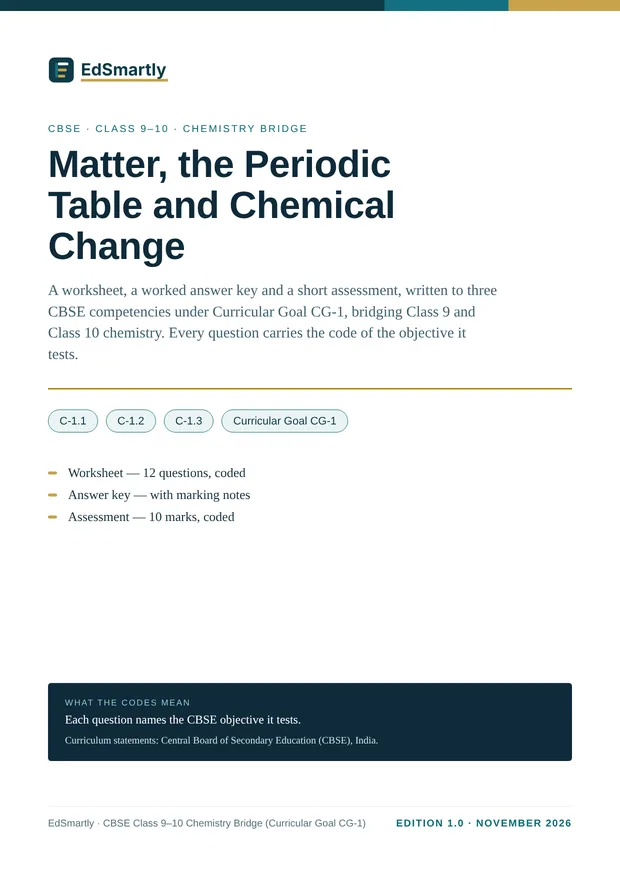
A 12-question worksheet, a worked answer key and a 10-mark assessment, written to CBSE competencies C-1.1, C-1.2 and C-1.3 under Curricular Goal CG-1, bridging Class 9 and Class 10 chemistry. Every question is coded to the objective it tests. Checked by a teacher.
PDF, 8 A4 pages. Paid through Stripe; the download link appears straight after payment and is emailed to you once. Print as many copies as you need for your own classes.
Edition 1.0 · November 2026. Your download link always gives the latest edition. Spotted something in a question or a marking note? Tell us in 30 seconds.
Try five questions free
Five questions from the pack, with the answer explained. They are marked in this page: your answers are not sent anywhere and are not kept.
What is in it
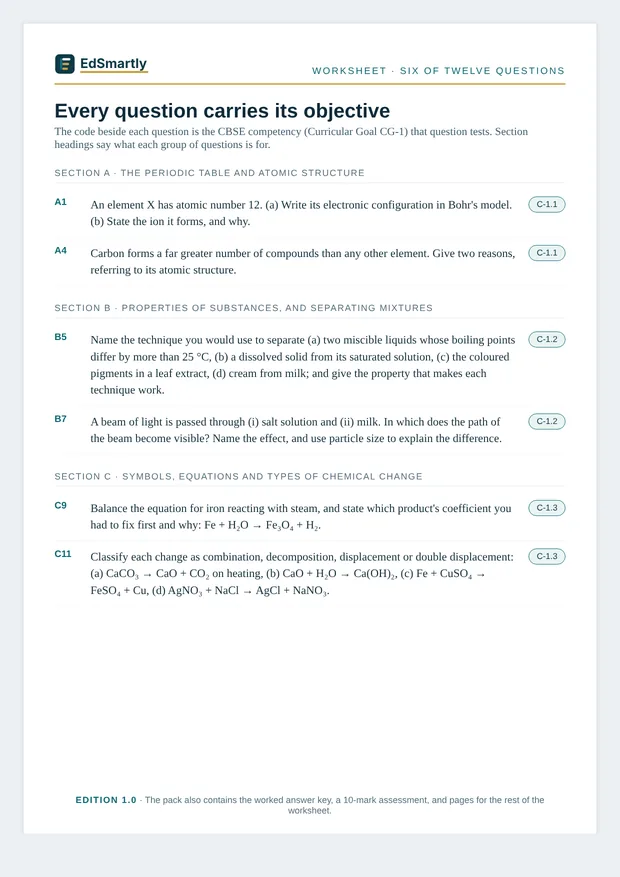
- Worksheet: 3 pages, 12 questions, four to each objective, with space to answer.
- Answer key: 2 pages of worked answers, with a marking note wherever a question is commonly half-answered.
- Assessment: 1 page, 10 marks, with a note on reading the result objective by objective.
- Coverage page: what each objective asks of a pupil, in plain classroom language, and which questions test it.
The objectives
| Code | What it covers |
|---|---|
| C-1.1 | How the periodic table sorts the elements, and how an atom's structure and valency explain the compounds it forms, carbon compounds included. |
| C-1.2 | How substances are investigated and mixtures separated (distillation, crystallisation, chromatography, centrifugation), and how solutions, colloids and suspensions differ. |
| C-1.3 | How chemical change is written and read back: symbols and balanced equations, acids and bases, metals and non-metals, reversible against irreversible change. |
Curriculum statements: Central Board of Secondary Education (CBSE), India. The objective codes are CBSE's; the descriptions of them, the questions, the answers and the marking notes are our own work.
Answers are included, so this is a teaching resource rather than a test to hand out blind: print the assessment page alone if you want it unseen. Something wrong in a pack? Write to support@edsmartly.com.