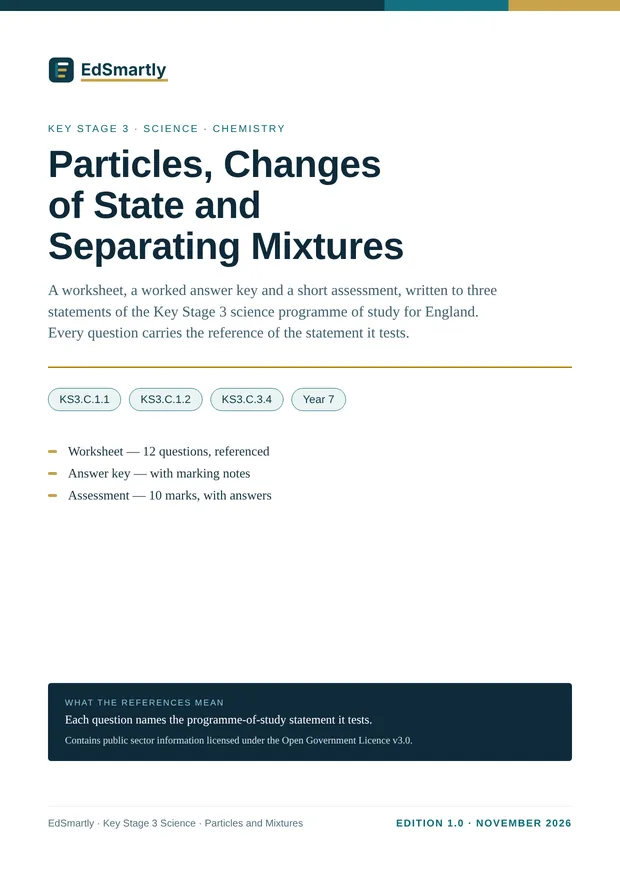
Key Stage 3 Science: Particles, Changes of State and Separating Mixtures
Chemistry for Year 7, England National Curriculum
A 12-question worksheet, a worked answer key and a 10-mark assessment with its answers, written to three statements of the Key Stage 3 science programme of study: the particle model, changes of state, and separating mixtures. Checked by a teacher.
PDF, 8 A4 pages. Paid through Stripe; the download link appears straight after payment and is emailed to you once. Print as many copies as you need for your own classes.
Edition 1.0 · November 2026. Your download link always gives the latest edition. Spotted something in a question or a marking note? Tell us in 30 seconds.
Try five questions free
Five questions from the pack, with the answer explained. They are marked in this page: your answers are not sent anywhere and are not kept.
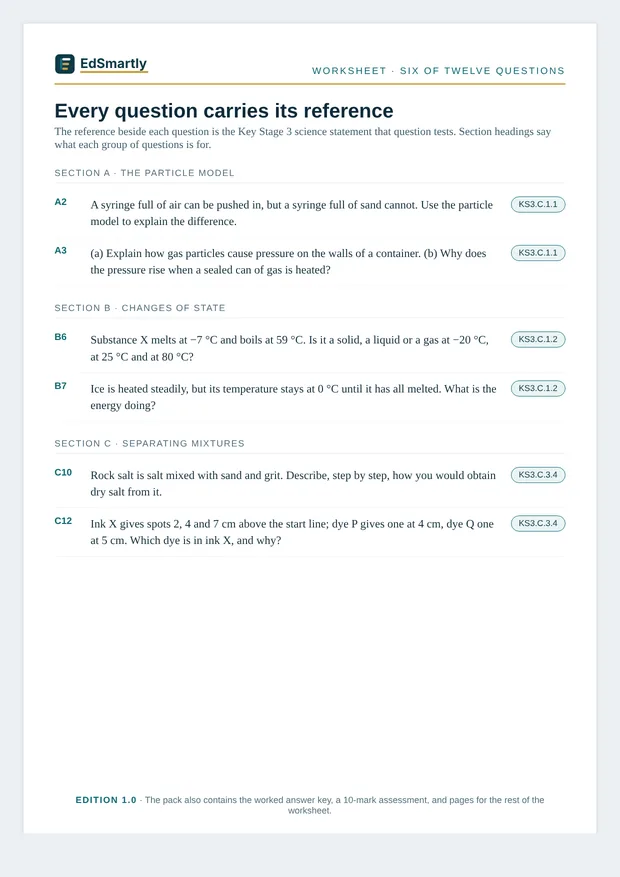
Worksheet: 3 pages, 12 questions, four to each statement, with space to answer.
Answer key: 2 pages of worked answers to the worksheet and the assessment, with marking notes that ask for the particle explanation, not only the fact.
Assessment: 1 page, 10 marks (three multiple-choice, three written), with a note on reading the result by statement.
Coverage page: what each statement asks of a pupil, in plain classroom language, and which questions test it.
The objectives
Code
What it covers
KS3.C.1.1
Using the particle model to explain how solids, liquids and gases behave, gas pressure included.
KS3.C.1.2
Using the particle model to explain changes of state: melting, freezing, evaporating, boiling and condensing.
KS3.C.3.4
Choosing and using simple techniques to separate mixtures: filtration, evaporation, distillation and chromatography.
Contains public sector information licensed under the Open Government Licence v3.0. Statements from the Key Stage 3 science programme of study (Department for Education). The references (KS3.C.1.1 and so on) are our own; the National Curriculum does not number its statements. The descriptions, questions, answers and marking notes are our own work.
Answers are included, so this is a teaching resource rather than a test to hand out blind: print the assessment page alone if you want it unseen. Something wrong in a pack? Write to support@edsmartly.com.